
For decades, small business owners faced a frustrating dilemma every time they needed to sign a new client: spend hundreds of dollars an hour on a legal team to draft a custom agreement, or download a free boilerplate template off the internet and cross their fingers that it held up in court.
Neither option worked well. Traditional legal drafting was too slow and expensive for fast-moving service businesses, while static templates often left critical scope gaps, payment terms, or liability protections exposed.
The rise of artificial intelligence has fundamentally changed this dynamic.
AI is not replacing legal oversight—it is removing the manual friction, copy-pasting, and endless drafting cycles that slow businesses down. Today, small businesses use AI to transform basic proposal details into legally sound, customized contracts in seconds rather than days.
Here is how AI is reshaping the contract creation process for modern entrepreneurs, agencies, and consultants.
The Death of the Static Contract Template
The traditional contract template is inherently flawed. It assumes every client project is identical.
When an agency owner uses a static Microsoft Word template for a new engagement, they usually spend 30 to 40 minutes hunting down variable fields: changing client names, adjusting payment schedules, editing deliverable descriptions, and trying to remember if they included the correct intellectual property clause.
Traditional Template Lifecycle (High Error Risk):
[ Generic Template ] ➔ [ Manual Find & Replace ] ➔ [ Unchecked Formatting Errors ] ➔ [ Legal Exposure ]
This manual process introduces human error. It is surprisingly easy to send a contract containing a previous client’s business name or an outdated payment term.
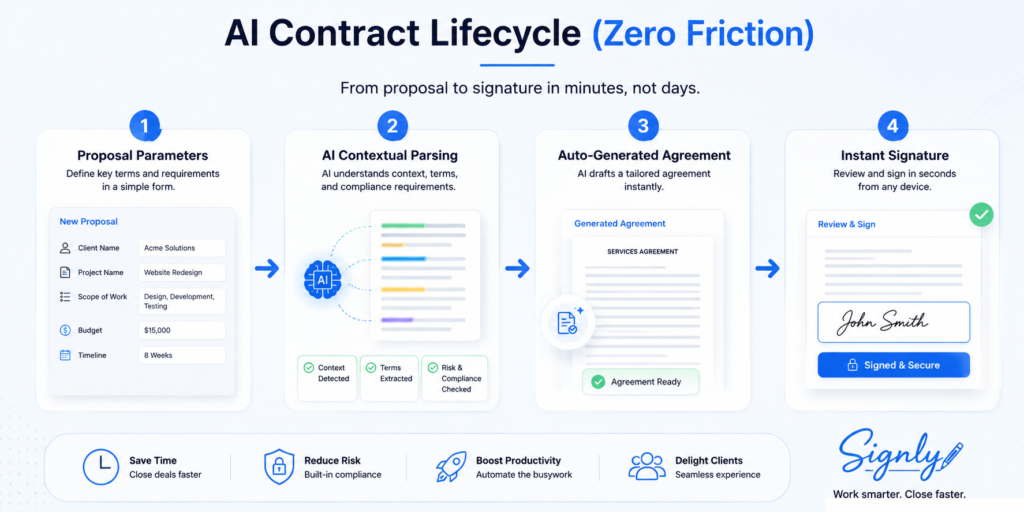
AI contract tools replace static files with dynamic logic. Instead of editing raw text, business owners input basic project parameters—such as scope boundaries, milestone payments, and cancellation terms—and the AI generates a clean, structured agreement tailored to that exact transaction.
1. Transforming Proposals into Binding Contracts in Seconds
One of the largest operational gaps in sales handoffs occurs between the proposal acceptance and the contract delivery. A prospect gives a verbal “yes” on a Zoom call, but the momentum stalls because the account team takes three days to prepare the legal agreement.
AI bridges this gap by unifying the proposal and contract steps:
- Scope Extraction: Advanced AI algorithms analyze agreed-upon proposal parameters and instantly extract key deliverables, timelines, and financial commitments.
- Contextual Clause Generation: Rather than pulling generic text, the AI selects specific clauses based on the industry type, payment structure, and jurisdiction.
- Instant Document Conversion: Instead of building a new document from scratch, the system generates a draft that is ready for review the moment the proposal is accepted.
2. Eliminating Back-and-Forth Scope Ambiguity
Miscommunication over scope is the primary driver of client disputes. When contracts contain vague statements like “Provider will manage social media,” clients often assume that includes video editing, community management, and ad spend strategy—services the provider never intended to offer.
AI contract engines reduce scope creep by enforcing clarity during creation:
- Granular Deliverable Outlines: AI tools prompt creators to specify limits (e.g., number of revisions, specific file formats, turnaround times).
- Plain-Language Definitions: AI translates complex legal terms into plain, clear language that both parties can understand without needing a law degree.
- Risk Identification: Smart contract assistants scan drafted documents to flag missing components—such as late-payment penalties or termination notice periods—before the document goes out.
3. Integrating eSignatures and Payments Directly into the AI Flow
A contract created by AI is only as useful as the system that executes it. In the past, drafting a document was just the first hurdle; you still had to export it to a PDF, re-upload it to an eSignature vendor, and create a separate invoice in your accounting software.
Modern platforms bring these functions together under one roof.
| Contract Feature | Traditional Manual Approach | AI-Powered Integrated Approach |
| Drafting Time | 1–3 hours per custom document | Under 60 seconds via guided AI inputs |
| Variable Customization | Manual copy-pasting into text files | Automated variable insertion & clause selection |
| Signature Collection | Separate eSignature app upload | Built-in, legally binding electronic signatures |
| Payment Trigger | Manual follow-up invoice sent later | Integrated payment collection attached to signature |
By embedding electronic signatures and payment processing directly into the document workflow, small businesses can collect signatures and first-month retainers or deposits in a single interactive session.
4. Reducing Legal Bills While Improving Compliance
Small business owners often avoid consulting legal counsel simply because of the cost. While AI does not replace qualified legal counsel for high-stakes corporate restructuring or complex litigation, it dramatically reduces basic legal overhead.
By utilizing AI-assisted platforms, businesses can:
- Maintain standardized, legal-grade clause libraries approved by their legal advisors.
- Ensure every outgoing agreement includes required regulatory language, such as data privacy standards or state-specific jurisdiction clauses.
- Generate complete audit trails that record exact timestamps, IP addresses, and viewing history for every signed document.
This operational shift allows business owners to reserve legal budgets for strategic counseling rather than paying hourly rates for administrative drafting.
How Signly Powers AI Contract Creation for Growing Businesses
Navigating multiple single-purpose tools—an AI writer here, an eSignature tool there, and a payment gateway somewhere else—adds unnecessary friction to your business.
Signly combines AI contract creation, electronic signatures, workflow automation, and payment collection into a single operational platform.
+-----------------------------------------------------------------------------------+
|                                 SIGNLY WORKFLOW                                   |
|                                                                                   |
|  [ AI Contract Generator ] ➔ [ eSignature Execution ] ➔ [ Integrated Payments ]   |
|                                                                                   |
|         ↓ (Automated Triggers)                                                    |
|  • Tamper-Evident Audit Trails                                                    |
|  • Automatic Expiration & Renewal Alerts                                          |
|  • Centralized Document Storage                                                   |
+-----------------------------------------------------------------------------------+
Here is how Signly helps small businesses modernize their agreement lifecycle:
- AI Contract Generator: Create professional, legally sound contracts in seconds. Input your project scope, and Signly handles the formatting, clause selection, and structure.
- Seamless eSignatures & Payments: Don’t wait for an invoice to clear after a document is signed. Signly allows clients to sign agreements and submit initial deposits or recurring payments simultaneously.
- Centralized Template Management: Store your core business templates, control team editing permissions, and let AI update variable fields dynamically across all client proposals and contracts.
- Automated Audit Trails & Compliance: Every executed document includes a full audit log detailing signer identities, IP locations, and verification timestamps, helping your business comply with legal standards recognized by organizations like the Small Business Administration.
Practical Takeaways for Business Owners
To bring AI into your contract creation process starting today:
- Identify your most frequent agreements: Outline the 3 to 5 contracts you use most often (e.g., Client Service Agreements, NDAs, Statements of Work).
- Standardize your core variables: List the specific terms that change per project (scope, payment milestones, revision limits) so your AI generator can auto-populate them accurately.
- Unify signing and payment: Choose a document platform that lets you collect electronic signatures and initial payments at the exact same time.
- Maintain an active clause library: Periodically review your AI templates to ensure your legal terms adapt alongside your evolving service offerings.
Frequently Asked Questions (FAQ)
Are AI-generated contracts legally binding?
Yes. A contract’s legal validity depends on basic contract law elements—offer, acceptance, consideration, and mutual intent—not whether the text was typed by a human or generated by software. When paired with legally compliant eSignatures under frameworks like the ESIGN Act, AI-generated agreements hold full legal weight.
Can AI completely replace my corporate lawyer?
No. AI excels at standardizing routine business contracts, organizing clauses, and removing administrative drafting work. For specialized regulatory matters, complex partner buyouts, or custom litigation protection, professional legal counsel is still recommended.
How does AI prevent errors in contract terms?
AI contract systems use predefined guardrails and structured input prompts to populate variable fields. This ensures critical terms—like deposit amounts or termination notices—are never accidentally left blank or misformatted.
Modernize Your Contract Creation Engine Today
Stop losing hours to manual contract drafting and disconnected payment links. Build a fast, seamless document experience that impresses clients and protects your bottom line.
- Looking for additional tools? Read about business management and operations frameworks hosted on platforms like Vonza.
- Want to explore eSignature standards? Check out dedicated signing tools like Signly.com
- Ready to create contracts in seconds? See how Signly can streamline your document workflows and speed up client closing today.
5. Signly Feature Integration & Internal Links
Feature Opportunities
- AI Contract Generator: Featured as the primary creation engine solving manual drafting slowness.
- Integrated Payments: Highlighted as the key feature for collecting deposits upon eSignature execution.
- Audit Trails & Reminders: Emphasized for legal protection, compliance, and automated follow-ups.


3 thoughts on “How AI Is Changing the Way Small Businesses Create Contracts”
Comments are closed.